

A Return to Myth
An essay on Myth, Purpose, and Meaning in Literature

Introduction
“On that side (as Author) I wrote fairytales because the Fairy Tale seemed the ideal Form for the stuff I had to say…” (Lewis). To the modern reader, it may seem odd that when describing his iconic work, The Chronicles of Narnia, C.S. Lewis refers to them as fairy tales, because it is now assumed that fairy tales are children’s tales adapted and bastardized into Disney films (Tolkien). Lewis and Tolkien were both intense critics of Walt Disney because both had a similar opinion, “Since it is so likely that children will meet cruel enemies, let them at least have heard of brave knights and heroic courage” (Lewis) and “[...] I recognize his talent, but it has always seemed to me hopelessly corrupted. Though in most of the ‘pictures’ proceeding from his studios, there are admirable or charming passages, the effect of all of them to me is disgusting. Some have given me nausea [...]” (Tolkien). They each felt that Disney stripped their films of any genuine darkness that a child might have to confront. Lewis and Tolkien were both profoundly Christian, Lewis a confessing Anglican and Tolkien a devout Catholic, which influenced their theology on Darkness and Light as defined by Scripture (English Standard Version, Jn. 1:5) compared to the secular Walt Disney studios. C.S. Lewis believed fairytales could, “…steal past watchful dragons” (Lewis), and shape a theological framework that had the power to change someone’s life. An author’s worldview shapes and motivates how they create literature. The worldview of the author’s work gives purpose to a piece of literature; through the analysis of The Fellowship of the Ring by J.R.R Tolkien and The Lion, the Witch, and the Wardrobe by C.S. Lewis, this essay will show why the Christian worldview is the superior purpose to creating literature.
The Price of Courage
J.R.R. Tolkien considered writing fantasy a theological labor. Influenced by his Catholic faith, he saw humanity as image bearers of a God (Gen. 1:27) who is creative (Gen. 1-2), and image bearers are “sub-creators” and able to create myth. The success of the Sub-Creator is when he creates a Secondary World, the fantastical world, that reflects the Primary World, earth, that, “Inside it, what he relates is ‘true’: it accords with the laws of that world. You therefore believe it, while you are, as it were, inside” (Tolkien 103) and a Sub-Creator has failed when, “The moment disbelief arises, the spell is broken; the magic, or rather art, has failed. You are then out in the Primary World again, looking at the little abortive Secondary World from outside” (Tolkien 103). Tolkien saw myth as the bedrock of fantasy because of how it dealt with the natural and the supernatural. In contrast to how modern readers view humanity in comparison to fairies, elves, and other mythical creatures, Tolkien believed that humanity is supernatural in comparison to these creations which were strictly natural, “Such is their doom. The road to fairyland is not the road to Heaven; nor even to Hell, I believe, though some have held that it may lead thither indirectly by the Devil’s tithe” (Tolkien 94). The myths were derived by mortal hands, whereas man was created by the Divine with an eternal destiny.
A common complaint about literature influenced by Christianity is a shallow exploration of good and evil. The weight of Tolkien’s faith is shown in the temptation that Frodo is faced with whenever he is put into a compromising situation. On his way to Rivendell, he and his companions are taken hostage by the Barrow-wights in the Barrow-downs. The struggle within Frodo’s soul to use the Ring to save himself from the hard situation is almost too much to bear for the poor hobbit, “But the courage that had been awakened in him was now too strong: he could not leave his friends so easily. He wavered, groping in his pocket, and then fought with himself again…” (Tolkien 176). Even though Frodo is a hobbit, the war that blasts through his soul is a struggle that every man could recognize within himself when he has to confront the content of his character. Tolkien makes the case through these events that to be good, courageous, and a person worth remembering is a conscious effort and battle against evil. And if temptation succeeds in its seduction, there are consequences. The moment that Frodo gives in to the siren call of the ring, he suffers from the piercing of a weapon that almost costs the hobbit his life (Tolkien 244). This point is further hammered by the effects of the Ring has on the existence and consciousness of Bilbo Baggins who struggles to initially leave the Ring for his heir, Frodo, to inherit (Tolkien 41) and again when Frodo and Bilbo have been reunited, “To his distress and amazement he found that he was no longer looking at Bilbo; a shadow seemed to have fallen between them, and through it he found himself eyeing a little wrinkled creature with a hungry face and bony groping hands” (Tolkien 287). It also showcases the theological idea, “It is perilous to study too deeply the arts of the Enemy, for good or for ill” (Tolkien 328), or you will be consumed by them, like Gollum, and like Bilbo if he had not had Gandalf.
Darkness is not Depth
The contrast of this idea is Game of Thrones by George R.R. Martin, whose fantasy works are known for their edgy material, creating the argument that “Tolkien’s writings are just ‘too simplistic […] for contemporary audiences,’ for the ‘more profane, more jaded, more ambivalent age than the one Tolkien lived in’” (Honegger 165). However, the audacity of that sentiment could be rebutted by C.S. Lewis in his writings on children and children’s tales, “…There is something ludicrous in the idea of so educating a generation which is born to the Ogpu and the atomic bomb. Since it is so likely that they will meet cruel enemies, let them at least have heard of brave knights and heroic courage. Otherwise, you are making their destiny not brighter but darker” (Lewis). Lewis and Tolkien lived within the same age. They existed during the age of modern warfare, the “Lost Generation” because so many died at the hands of trench warfare, the Great Depression, the holocaust, the atomic bomb, and the rapid advance of secularization as a reaction to the disillusionment with God and the confrontation of man’s wickedness. Tolkien wrote about evil with a deep understanding of its effects and side effects on the human soul. His faith grounded him to not become overtly fascinated and consumed by the evil he wrote about, to write about the clash of the natural with the supernatural.
The critique “simplistic” is often used by someone who has lost all meaning of story beyond the pluralistic, morally ambiguous exploration of the depravity of man. George Orwell who was famous for his dystopian realities where storytelling lost all of it’s meaning because language became buried under a mound of meaningless and purposeless words wrote an essay, “Politics and the English Language” where he writes, “…becomes ugly and inaccurate because our thoughts are foolish, but the slovenliness of our language makes it easier for us to have foolish thoughts” (Orwell 1) which can be counteracted by dwelling on things that are, “…whatever is true, whatever is honorable, whatever is just, whatever is pure, whatever is lovely, whatever is commendable, if there is any excellence, if there is anything worthy of praise, think about these things” (Phil. 4:8). A crucial reality of writing is that there must be a purpose for the words he writes for as the father of fantasy George MacDonald writes in his essay, The Fantastic Imagination, “You write as if a fairytale were thing of importance: must it have meaning? It cannot help having some meaning; if it have proportion and harmony it has vitality, and vitality is truth. The beauty may be plainer in it than the truth, but without the truth the beauty could not be, and the fairytale would give no delight” (MacDonald) and “A genuine work of art must mean many things; the truer its art, the more things it will mean” (MacDonald).
The Truth of the Matter
Truth is the heart of writing fiction, even when dealing with orcs, hobbits, goblins, or dragons, because the exploration of these natural beings points to deeper realities that are difficult to explore in realistic fiction. If truth remains abstract, writing and storytelling suffers, “As soon as certain topics are raised, the concrete melts into the abstract and no one seems to think of turns of speech that are no hackneyed: prose consists less and less of words chosen for the sake of their meaning, and more and more of phrases tacked together like sections of a prefabricated henhouse” (Orwell 3). This occurs as a side-effect of a post-modern society which, “…emphasizes contextual construction of meaning and the validity of multiple perspectives” (Wilson 10). In George R.R. Martin’s Game of Thrones, the purpose of his stories is to subvert classic medieval tropes and history, but the end is simply empty, crumbling, bloodstained walls that have no support to hold them up because subversion will never replace Truth in storytelling. The contrast between Martin and Tolkien shows that to explore darkness and evil, it does not have to consume the story. Perhaps the critic of Tolkien mistook depth with gratuitous bloodshed and post-modern pluralism for truth.
It is cheap writing that can only write to the excitement of bloodshed, lust, and a perversion of the fairytale. It was cheap when the Romans appealed to this bloodlust and perversion through the Gladiator games, and it remains a cheap imitator still. One of the elements that makes The Lion, the Witch, and the Wardrobe by C.S. Lewis stand out is its appeal to all. It’s the methodology of Lewis who supposed that, “… casting all these things into an imaginary world, stripping them of their stained glass and Sunday school associations, one could make them for the time appear in their real potency?” (Lewis). To the reformed atheist, storytelling and fairytales were not simply children’s stories, meant to tickle fancies, but to tell the reader of profound realities and theological Truths. Lewis admits that he never started a story with a theological idea in mind, but with bits of image (Lewis); however, guided by his faith, it would turn into a story rich with symbolism and meaning that, no matter how many times someone opened the pages, would be surprised, delighted, and renewed by what they found inside. The reason the story is so rich is the realities that are found reflected back to man through the Secondary World. The Pevensie siblings escape from war-torn England, where human dignity is threatened by the blitz’s raging through London. In this new world, they are constantly referenced as Sons of Adam and Daughters of Eve, initially with fear and degradation by the White Witch and then with dignity by Aslan and awe by the creatures of Narnia (Lewis 32, 171). This reflects the natural order and hierarchy found in the Creation narrative (Gen. 1, 2) when man is created as the climactic moment, before all of creation rests. This emphasis of dignity is found again through the contrast of the White Witch turning all those who follow her into stone statues who cannot think, eat, sleep, play, or pray (Lewis 90), but once Aslan has broken the stone table, they become flesh and blood once again (Lewis 158). It is strikingly similar to, “And I will give you a new heart, and a new spirit I will put within you. And I will remove the heart of stone from your flesh and give you a heart of flesh” (Ezek. 36:26). Lewis is writing about the ultimate battle of goodness and wickedness, in a fairytale. Aslan quotes to the White Witch at the night of his execution, “‘Let’s say I have forgotten it,’ answered Aslan gravely, ‘Tell us of this Deep Magic’” (Lewis 132) he is reflecting Christ when says, “Do not think that I have come to abolish the Law or the Prophets; I have not to abolish them but to fulfill them” (Mat. 5:17).
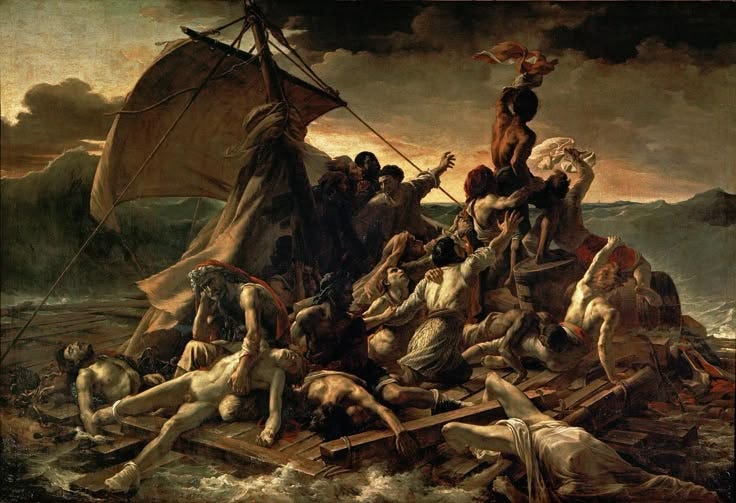
Ships on the Crest of Waves
Stories without purpose are like meandering ship vessels on the crest of waves, hoping they will be propelled to some meaningful piece of land. However, without a map, they have no direction in which to travel. Tolkien believed that men are Sub-Creators, a gift given him by his Creator, the One who carved mountains out of the depths of nothing, and seas out of the void. It is a fact that man is incapable of creating from ex nihilo – out of nothing – so it must be reasoned that there was a beginning to this ability to create. The beginning must have been Divine because the void is shapeless, meaningless, and abstract, but earth is not, as any human can see the sun rise into the sky, a ball of gas positioned with such precision that any closer or farther the earth would be incinerated or frozen. This matters because the One who hung that ball of gas was infinitely Creative, and if He is the One who created and instilled man with the ability to create, He is also the One who defines what makes something good or bad in the objective sense. When man creates, detached from this objective reality, words, language, and stories become, like Orwell writes, “The whole tendency of modern prose is away from concreteness” (Orwell 7). In essence, they begin to mean nothing.
Conclusion
Lewis and Tolkien didn’t hate Disney because they simply detested modernity; they hated Disney because the new films stripped the original myths of their purpose. In the minds of the two giants of fantasy, myths are not just fantastical but deeply purposeful and pointed to a more concrete, truthful reality. In the mind of the Christian this makes complete sense as a believer cannot separate objectivity from his pursuits, but to the mind of an atheist, or just an unbeliever, it compels them to view Tolkien’s, “… ultimate outcome of the main threads in the sense that the evil is always defeated by the good (though almost always at a very high price)” (Honegger 166) as simplistic or even cliché. The ultimate purpose of storytelling is lost when the view of the Creator is abstracted and replaced by the fascination of the very abstractions that took their eyes from the Ultimate Source of creativity to begin with. In this new “reality” where storytelling has no purpose or meaning beyond the vague idea of what the author means to say, it makes sense as to why subversion and perversion become the primary focus of a tale, as without the revelation of a greater, eternal, Divine reality, that is the crux of humanity – hopelessly wicked and corrupt (Jer. 17:9).
The myths of a culture reflect what flows from their hearts. In the present, it is post-modern, nihilistic, meaningless romps whose entire purpose is to subvert. This fact extends beyond Game of Thrones as BookTok and “romantasy” have grown in prevalence through literature spaces in the last three years, with just the romance genre making $1 billion alone in 2025 (Taylor). Literature has become fascinated by the very thing Tolkien warned against in The Fellowship of the Ring, because evil is hypnotic even to those who wish to be able to resist its pull. However, the path to creating great works of literature is not lost to man, even if the path is a little overgrown. Write with Truth in mind. Create stories with the knowledge that man was created to create. Travel into the shadows, like Frodo, but knowing that to write of light things overcoming dark things is one of the most honest stories one could tell (Rev. 21:23). It is time to return to stories that have meaning, purpose, and an accurate view of creating – it is time to return to myth. A return, that is to bring back great, truthful literature.
What did you find interesting about today’s article? Continue the conversation by leaving a comment!
Do you love articles on creating beautiful literature, discussions on cultural and theological matters, and the ramblings of a story-obsessed college student? Consider supporting me to keep writing!
Works Cited
Honegger, Thomas. “Tweaking a Little: Essays on the Epic Fantasy of J.R.R. Tolkien and G.R.R. Martin.” Walking Tree Publishers, 2023.
Lewis, C.S. “Sometimes Fairy Stories May Say Best What’s to be Said.” The New York Times, 1956.
Lewis, C.S. The Lion, the Witch, and the Wardrobe. The Chronicles of Narnia. Harper Collins Publishers, 1950.
MacDonald, George. “The Fantastic Imagination.” The George MacDonald Society. 2024.
Orwell, George. “Politics and the English Language.” 1946.
Taylor, Drew. “The Most Influential Genre In America Is Rewriting How Women Think About Love, And Conservatives Aren’t Even In The Room.” Evie Magazine, 2026.
The ESV Journaling Bible. Crossway, 2001.
Tolkien, J.R.R. “Tales from the Perilous Realm.” Harper Collins, 2008.
Tolkien, J.R.R. The Fellowship of the Ring. Harper Collins Publishers, 2004.
Wilson, Brent G. “The Postmodern Paradigm.” University of Colorado at Denver, 1997,
I’m honestly surprised you didn’t directly quote from Tolkien’s essay “On Fairy Stories.” If he had not written “Lord of the Rings,” he most definitely would have still been famous for that essay. You drew ideas from the essay though (especially the sub-creator part). And I agree with you; Disney really cheapened the idea of the fairy tale and made it too much about sentimentalism, exaggerated humor, and allegory. Tolkien preferred applicability over allegory; freely allowing readers to find meaning, not the other way around. Overall, great article! 👍